

Visiting the Mouriès and Alpilles region
Located in heart of the Alpillesyou can take advantage of traditional Provencal markets where the spicy scents will accompany you on those sunny mornings...
For Golf enthusiastsis to 20 metres from the Hotel that a 35-hectare course awaits you at the foot of the Alpilles, where nature, peace and pleasure are in harmony with the song of the cicadas and the beauty of the lavender.
Within a 50-kilometre radius, there will be a wide range of discoveries, from the Camargue to theAvignon with its Palais des Papes, passing by the Arènes d'Arles and its old town, the Château des Baux de Provence or Glanum in St Rémy de Provence...
See also: the Daudet mill (Fontvieille), Aix en ProvenceNîmes, Eygalièresthe Fountain of Vauclusethe Mont Ventoux, Roussillon, Senanque Abbey...The Region
Les Baux de Provence
The village of Les Baux de Provence, nestling close to the magnificent Château de Servanes, is now primarily a renowned tourist destination, even before it is a place to live. Listed as one of the most beautiful villages in France, it attracts over one and a half million visitors every year. Despite this, only 22 residents still live in Les Baux, the upper part of the village, while the commune has a total population of 381.
Perched in the heart of the Alpilles on a rocky plateau at an altitude of 245 metres, the village offers exceptional panoramic views of Arles, the Camargue and the Alpilles, providing breathtaking scenery. The majestic stone fortress that dominates the village is undoubtedly one of Provence's must-see attractions.
The vast underground quarries of Les Baux-de-Provence, world-famous for inspiring Jean Cocteau to make his film "Le testament d'Orphée", were transformed into a sound and light show venue in 1978. The quarry's walls, pillars and floors are used as projection screens for performances of masterpieces, plunging visitors into colourful worlds to the rhythm of the music. More than a hundred video projectors broadcast images over an area of more than 7,000 square metres, offering a unique visual experience. Don't miss the Carrières de Lumières immersive exhibition.

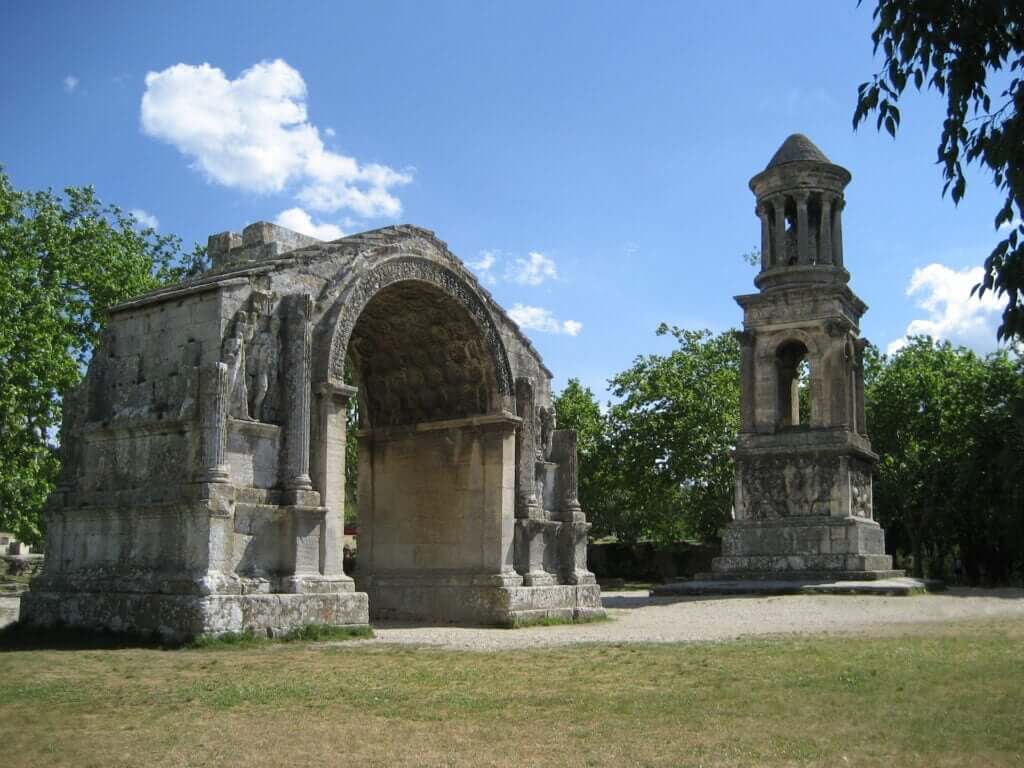
Saint-Rémy-de-Provence
Located just 10 km from the Château de Servanes in Mouriès, Saint-Rémy-de-Provence is a town rich in history and charm. First a Roman town, then a Renaissance town, it has also been home to many painters and writers.
Saint-Rémy-de-Provence is one of the oldest towns in France, with remains dating back to the first millennium BC. However, it was under Roman imperial rule that the town really flourished.
The town has preserved many remains from the Roman era, including the site of Glanum, one of the most important ancient sites in France. Here you can admire the ruins of a monumental centre, including a forum, a basilica and a curia.
Arles
Just 20 km from the Château de Servanes, Arles is a crossroads of history and culture. First populated by the Celts, then colonised by the Greeks, it became a Roman town thanks to Caesar, who settled there in 46 BC with the veterans of his legions. This marked the beginning of the first golden age of the "little Rome of the Gauls", which became a major religious centre at the beginning of Christianity. Although ravaged by the invasions of the early Middle Ages, the city was reborn in the 12th century, and its splendid medieval monuments bear witness to the vitality and wealth of that era.
The 17th and 18th centuries saw the construction of many private mansions, which still add to the charm of the old town today. The old town is home to a number of listed monuments that bear witness to 2,000 years of history. Since 1981, all the Roman and Romanesque monuments have been listed as UNESCO World Heritage Sites, making Arles a city of art and history.
And don't miss the Rencontres de la photographie. Since 1970, this summer event has presented over forty exhibitions in some of the city's outstanding heritage sites, helping to pass on the world's photographic heritage and serving as a breeding ground for contemporary creative work.


Avignon
Just 30 km from the château is Avignon, also known as the "City of the Popes" or "Altera Roma". The city still bears the indelible imprint of the residence of the Popes, who for a time made it the capital of the medieval West. Today, it shines as a cultural capital, thanks in particular to its world-renowned Theatre Festival.
A visit to Avignon will allow you to discover historic treasures such as the Palais des Papes and the Pont Saint-Bénézet, both UNESCO World Heritage sites, as well as renowned museums such as the Musée du Petit Palais, the Musée Angladon, the Palais du Roure and the Maison Jean Vilar. On the other side of the Rhône, opposite Avignon, you'll find a host of other monuments, including the Chartreuse, the Tour Philippe le Bel, the Fort and the Abbaye Saint-André.
The Camargue
Just an hour's drive from Château de Servanes is the Camargue, a site of vital national importance for local birds, migrants and, in particular, wintering species. Between 2000 and 2005, the Camargue was the main wintering area in France, hosting 122,000 birds each year, ahead of the Bay of Arcachon, which hosted 105,000.
The Camargue is also renowned as the habitat of the pink flamingo. In 1928, the botanical and zoological reserve was created. Bull breeders are dedicated to promoting the Camargue horse breed and the Taureau AOC. Rice growing is an essential part of Camargue agriculture.
The region's most famous sites include Le Grau du Roi, Aigues-Mortes and, of course, Les Saintes-Maries-de-la-Mer, not forgetting the magnificent sandy beaches.


Pont du Gard
Just an hour's drive from Château de Servanes lies one of the jewels of Roman architecture: the Pont du Gard. Admirably integrated into an unspoilt natural site, the bridge fascinates every visitor with its elegance and rugged grandeur.
Even two thousand years after its construction, this ancient edifice remains a masterpiece, as much for its technical prowess as for its sheer beauty. By spanning the Gardon river, it still ensures the continuity of the Roman aqueduct that carried water from Uzès to Nîmes.
Listed as a World Heritage Site since 1985, the Pont du Gard attracts 1.5 million visitors a year, making it the second most visited monument in France after Mont Saint-Michel.
Discover the rooms at Château de Servanes
Combining charm and modernity, Château de Servanes offers rooms with different characters.
